AI Overview optimization: how to rank in AI Overviews
AI Overview optimization is making the pages you already have easy for Google's AI to find, trust and quote. Google's own guide says AI Overviews run on the same SEO basics as regular search, with no extra requirements.
how much does a roof repair cost in coeur d'alene
AIAI Overview
Most roof repairs in the area run a few hundred dollars for small leaks and more for storm damage. Your Business says a typical shingle repair takes one visit, and they give a written estimate after a free inspection.
Your BusinessSource 2Source 3
Illustration, not a real AI Overview.
Question 1
What is AI Overview optimization?
Short answer
AI Overview optimization is making your existing pages easy for Google's AI to find, understand and quote. Google says it uses the same SEO basics as regular search.
AIAI Overview
how long does a roof repair take
Your BusinessSource 2
A short answer above the regular results. Google shows one only when it adds something to the search.
AIAI Mode
Should I repair or replace a 20-year-old roof?
Your BusinessSource 2Source 3
A full AI chat for harder questions and comparisons, with links to supporting websites.
Illustration, not real Google results.
“There are no additional requirements to appear in AI Overviews or AI Mode, nor other special optimizations necessary.”
AI Overviews are the AI-written answers at the top of some Google searches. AI Mode is the full chat version. Both quote websites and link to them.
You don't need a new kind of page or a special file. You need the pages you already have to be easy to find, easy to read and worth quoting.
Question 2
How do you rewrite a page to rank in AI Overviews?
Short answer
To rank in AI Overviews, lead each page with a direct answer to the question. Then use question headings and add real numbers, sources and first-hand detail.
Example: a made-up sign shop's opening paragraph, before and after
Before: 5 words
Quality craftsmanship you can trust.
Says nothing a customer asked
No place, no product, no number
Nothing an AI tool can quote as a fact
After: 36 words
We make custom acrylic boat lettering and business signs in Fort Myers, Florida, and ship them nationwide. Most orders are designed, cut and shipped in about 10 business days, and every piece is sized to fit your boat or wall.
Answers what, where and how long
One clear fact per sentence
Real details only this business can give
A made-up sign shop, for illustration. Short, vague openings like the "before" are what an AI visibility audit flags as a weak direct answer.
ALead with a direct answer
Open each page with 25 to 50 words that answer the main question: what you do, for whom, where. Microsoft Advertising's October 2025 guide to AI search lists "Self-contained phrasing: Sentences that make sense even when pulled out of context."
Prompt: rewrite your opening paragraphWorks in ChatGPT, Claude or Gemini. Check every fact before you publish.
Here is the opening paragraph of my page about [topic]: [paste it]. Rewrite it into one paragraph of 25 to 50 words that directly answers the question "[the question your customers ask]". Name my business, what I do and where. Use only facts that are already in my paragraph or that I list here: [your facts]. Don't add claims or numbers.
BMake headings the questions people ask
"How much does a roof repair cost in Coeur d'Alene?" beats "Pricing." Then answer each heading in its first sentence.
CAdd numbers, sources and first-hand detail
The Princeton GEO study tested nine ways to get quoted more in AI answers and found GEO "can boost visibility by up to 40% in generative engine responses." Google asks for the same thing in plain words: "Create the content yourself based on what you know about the topic."
Method tested in the GEO study
Change in AI-answer visibility
Add quotations from credible sources
+41%
Add statistics
+31%
Make the writing flow better
+28%
Cite your sources
+27%
Keyword stuffing
8% worse than doing nothing
Position-adjusted word count, Table 1 of the GEO paper (KDD 2024), compared with the same page left alone.
What this means for you
Google also says "You don't need to write in a specific way just for generative AI search." That's the point: an answer first, clear headings and real numbers are what people want. They also happen to be what AI tools quote.
Google's AI runs several related searches at once and quotes pages its core ranking systems retrieve. A page must be indexed and eligible to show with a snippet.
How much does a roof repair cost in Coeur d'Alene?
The page that answers one of those smaller searches clearly can be quoted in the answer.
“A set of concurrent, related queries generated by the model to request more information and fetch additional relevant search results to address the user's query.”
Google's AI doesn't invent a new ranking system. It uses Google's core ranking systems "to retrieve relevant, up-to-date web pages from our Search index," then builds the answer. So a page that ranks well for the smaller, specific questions is the page that gets quoted. Our query fan-out guide shows how to find those questions and answer them.
Two rules from Google decide whether you're even in the running: the page must be indexed, and it must be "eligible to be shown in Google Search with a snippet."
ChatGPT works the same way: it searches the web and recommends from what it finds. Here is how to rank in ChatGPT too.
Question 4
What should you check before you optimize for AI Overviews?
Short answer
Before AI Overview optimization, check that Google can crawl the page, index it and show it with a snippet. A free AI visibility check tests crawler access in about 10 seconds.
Googlebot isn't blocked: robots.txt allows it and the page needs no login
The page works: Google gets an HTTP 200 status, not an error page
The page is indexed: check it with URL Inspection in Search Console
No nosnippet tag, because AI Overviews only link pages that can show a snippet
Rewriting a page Google can't read is wasted work. Run the check first, fix anything red in crawler access, then move on to the writing.
Question 5
What AI Overview tricks should you skip?
Short answer
The AI Overview tricks to skip are llms.txt files, chopping pages into tiny chunks and chasing fake mentions. Google's own guide says you can ignore all three.
“For Google Search, you can ignore tactics like "chunking" content, creating unnecessary AI text files (like llms.txt), or pursuing inauthentic mentions.”
“You don't need to create new machine readable files, AI text files, markup, or Markdown to appear in Google Search (including its generative AI capabilities), as Google Search itself doesn't use them.”
One strong page per real question beats twenty near-copies.
What this means for you
If someone sells you an "AI Overview package" built on llms.txt files, chunked pages or bulk mentions, ask them to show you where Google says it works. Google says the opposite.
Our llms.txt guide shows what that file is, who requests it and why it won't move your rankings.
Question 6
Do you need structured data for AI Overviews?
Short answer
No, AI Overviews don't need structured data or any special schema markup. Keep the structured data you have when it matches what the page shows.
“Structured data isn't required for generative AI search, and there's no special schema.org markup you need to add.”
Illustration. Same name, phone, hours and area in both places.
What this means for you
Keep your LocalBusiness and article structured data, and make every value match what the page shows. In its May 21, 2025 post on AI search, Google's advice fits in one line: "Make sure structured data matches the visible content".
FAQ markup no longer earns a rich result. Google's changelog says the FAQ rich result "will no longer appear in Google Search starting May 7, 2026." This page still carries FAQ markup, built word for word from the recap at the bottom.
Our schema markup guide lists the four types a small business needs, with a template to copy.
To know if you show up in AI Overviews, check the Generative AI performance report in Google Search Console. Then search your main questions yourself and watch impressions over a few months.
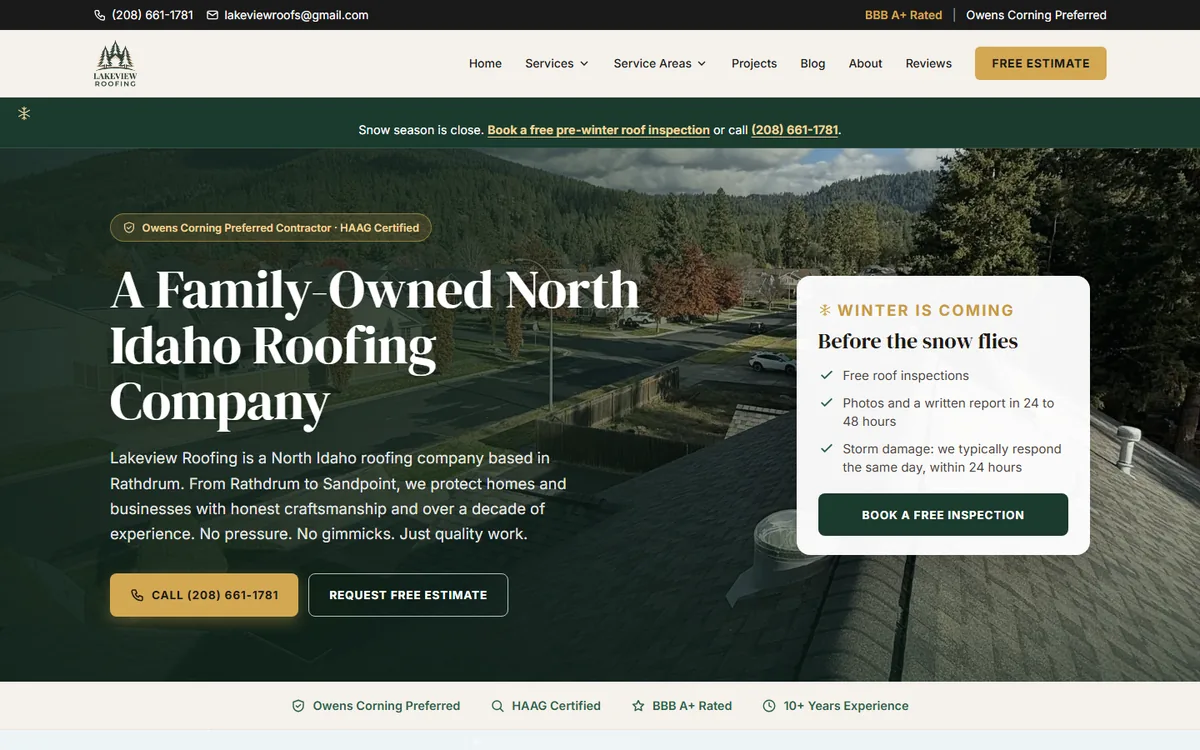
Roofing company, North Idaho
Lakeview Roofing
3.7xmonthly impressions, June to Oct
30,906Google impressions
Up 5spots in average position
Monthly Google impressions grew from 2,916 in June to 10,859 in October. Its average position moved up from 25.7 to 20.5 (lower is better).
Google's guide points to the Generative AI performance report.
Search it yourself
Type your main customer questions into Google and see who gets quoted.
Give it months
Lakeview's monthly impressions grew from 2,916 in June to 10,859 in October 2026 as pages added up.
Impressions are how many times a site showed up in Google results.
Lakeview numbers: Google Search Console, one site, June to October 2026. Impressions count every Google result, not only AI Overviews.
Tracking Copilot and ChatGPT too? Our AI visibility tracking guide covers four free ways, including Bing's AI Performance report.
Question 8
Can someone do AI Overview optimization for my business?
Short answer
Yes, an AEO expert can do AI Overview optimization for you. I build the pages on Halo, quoted for your business, or you can run Halo Pro yourself for $99 a month.
What this means for you
Halo is the AI website you run by text that I build on. Every Halo site ships with sitemaps, structured data and an AEO readiness score, so the settings on this page are handled. You text Halo the questions your customers ask, and it builds the pages. Lakeview Roofing, built on Halo, scored 97 out of 100 on the AEO Site Checker on November 12, 2026.
Texting HaloRewrite the top of my roof repair page so it answers the cost question first.On it. I'll text you when it's live.It's live: yourbusiness.com/roof-repair
Get it built by an AEO expert
I'm an AEO and local SEO specialist. I find the questions your customers ask and build answer-first pages for them on Halo.
Halo Pro is $99 a month for two websites on your own domains, and Halo Start is free for one page.
Checked on huzihalo.com, November 16, 2026. Prices can change.See Halo pricing
The short version
AI Overview optimization: every answer in one place
What is AI Overview optimization?
AI Overview optimization is making your existing pages easy for Google's AI to find, understand and quote. Google says it uses the same SEO basics as regular search.
How do you rewrite a page to rank in AI Overviews?
To rank in AI Overviews, lead each page with a direct answer to the question. Then use question headings and add real numbers, sources and first-hand detail.
How does Google pick pages for AI Overviews?
Google's AI runs several related searches at once and quotes pages its core ranking systems retrieve. A page must be indexed and eligible to show with a snippet.
What should you check before you optimize for AI Overviews?
Before AI Overview optimization, check that Google can crawl the page, index it and show it with a snippet. A free AI visibility check tests crawler access in about 10 seconds.
What AI Overview tricks should you skip?
The AI Overview tricks to skip are llms.txt files, chopping pages into tiny chunks and chasing fake mentions. Google's own guide says you can ignore all three.
Do you need structured data for AI Overviews?
No, AI Overviews don't need structured data or any special schema markup. Keep the structured data you have when it matches what the page shows.
How do you know if you show up in AI Overviews?
To know if you show up in AI Overviews, check the Generative AI performance report in Google Search Console. Then search your main questions yourself and watch impressions over a few months.
Can someone do AI Overview optimization for my business?
Yes, an AEO expert can do AI Overview optimization for you. I build the pages on Halo, quoted for your business, or you can run Halo Pro yourself for $99 a month.